Dark Matter Galaxy CDG-2: A Cosmic Puzzle Unveiled by Astronomers
Imagine a galaxy so elusive, so ghostly, that it barely registers on our telescopes. That's the enigma of CDG-2, a cosmic oddity that's making astronomers rethink what they know about the universe. We all know that dark matter is the invisible hand shaping the cosmos, and this galaxy might just be the smoking gun.
Last year, some stargazers were trying to find candidate for dark galaxies. They were looking for galaxies with dim surfaces, according to a paper published in The Astrophysical Journal Letters, surmising that these dark galaxies should have some extreme properties compared to other common ones. And you know what? They may have found one!
NASA just dropped some high-resolution images of CDG-2, and if the initial hunches are right, this galaxy could be packed with more dark matter than anything we've ever seen. What makes dark matter so intriguing is that it doesn't play by the usual rules. It doesn't emit, absorb, or reflect light, making it practically invisible. However, scientists can tell it's there by the way its gravity tugs on everything around it.
It's like trying to find a ghost, you can't see it, but you can definitely feel its presence. Without dark matter, the models we use to understand the universe would just fall apart.
Hidden in Plain Sight
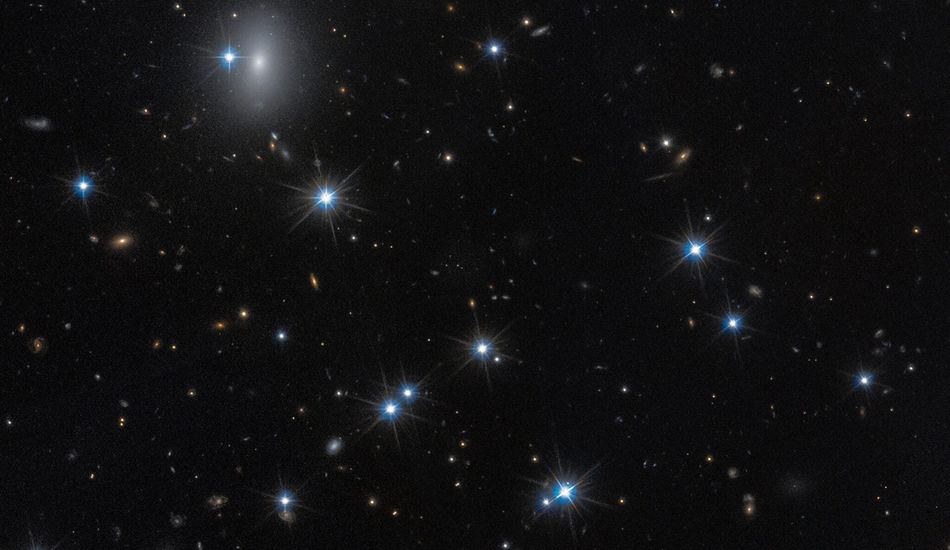
CDG-2 is hanging out in the Perseus galaxy cluster, a bustling neighborhood filled with globular clusters – those tightly packed balls of millions of stars. This area is already known for its dense population of stars, but CDG-2 adds a whole new level of weirdness to the mix.
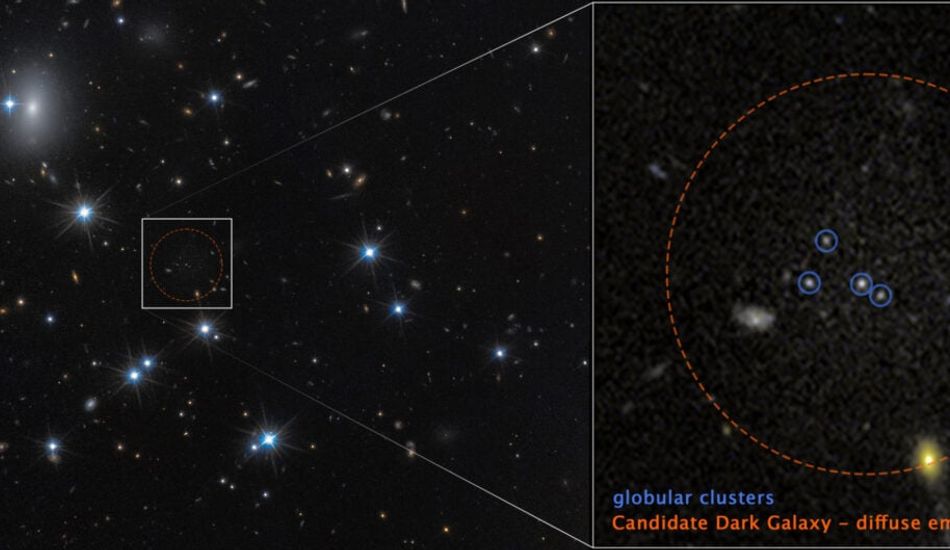
When the Hubble telescope, along with the ESA's Euclid and the Subaru Telescope in Hawaii, took a closer look, they spotted a faint glow around a group of four globular clusters. This made them wonder if it was all just one galaxy. After some digging, astronomers think those four clusters are part of a single, dark galaxy.
As David Li, an astronomer at the University of Toronto, said, "This is the first galaxy detected solely through its globular cluster population”.
Now, here's where things get really interesting. CDG-2 might shine as bright as 6 million suns, but about 99% of its mass seems to be dark matter. It's like a cosmic iceberg, with only a tiny fraction visible above the surface.
So, what happened to all the "normal" stuff, like hydrogen gas for making stars? Well, scientists think the crowded environment of the Perseus cluster probably stripped it away. Even if CDG-2 isn't a true "dark galaxy," it's still a really weird one. The scientists also mentioned that CDG-2 is the perfect test subject for the formation of stars clusters.
So, while dark matter remains one of the universe's biggest mysteries, CDG-2 could be the key to unlocking its secrets. I, for one, will be watching this story closely as it develops.
1 Image of Dark Matter:
Source: Gizmodo