NASA's asteroid crash altered its orbit around the sun: A huge win for planetary defense!
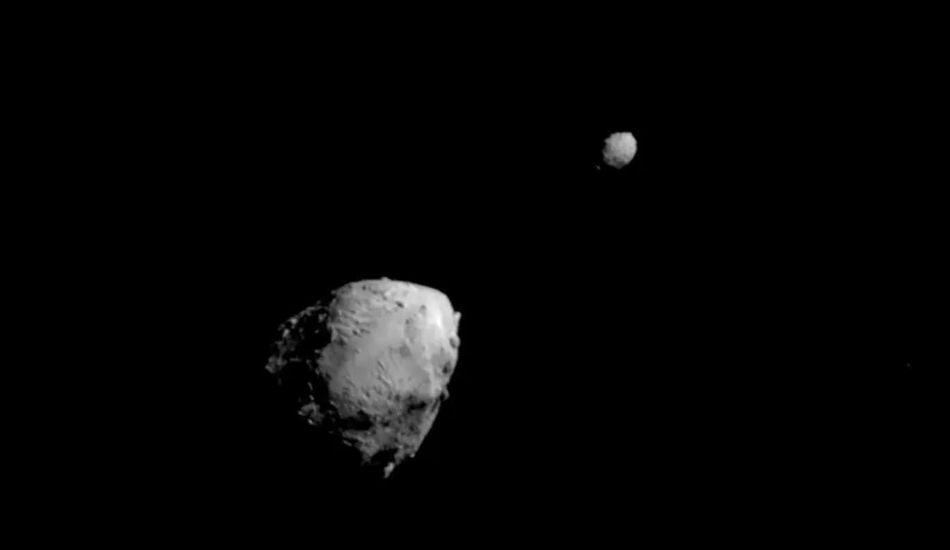
Okay, so NASA did something pretty wild back in 2022. They basically crashed a spacecraft into a small asteroid moon, Dimorphos. Now, you might be thinking, "Why would they do that?". Well, it wasn't just for kicks. The whole point was to see if we could actually change the path of an asteroid. And guess what? It totally worked!
I mean, we're talking about altering not just Dimorphos' orbit around its bigger asteroid buddy, Didymos, but also the orbit of the whole system around the sun. How cool is that? The Jet Propulsion Laboratory (JPL) folks are calling it the first time we've ever managed to measurably change the path of a celestial object around our star. This is a pretty big deal, since we may need this technology someday.
The mission was called the Double Asteroid Redirection Test (DART), and its goal was simple: show that we could potentially deflect a dangerous space rock heading our way. Dimorphos, being a harmless little guy, was the perfect target. Initial reports after the crash were promising, showing that Dimorphos' orbit around Didymos had been shortened.
A more in-depth study, published in 2024, revealed that Dimorphos' orbital period was reduced by about 33 minutes. Moreover, its path was nudged roughly 120 feet closer to Didymos than before. That's some serious precision!
But here's the real kicker: the latest research shows that the entire binary system was affected. Didymos and Dimorphos take about 770 days to orbit the sun. According to Rahil Makadia, the lead author of the study, the crash changed that orbit by about 11.7 microns per second, or roughly 1.7 inches per hour. Now, I know what you're thinking: "That's nothing!".
However, Makadia explains that even tiny changes like that can have a huge impact over time. A seemingly insignificant nudge could be the difference between a hazardous asteroid hitting Earth or sailing harmlessly by. It is like pushing a swing: small pushes makes it go further.
So, while it might not be as dramatic as something you'd see in a sci-fi movie, this is a massive step forward in planetary defense. It's proof that we're not entirely helpless against the dangers lurking in space. And honestly, that's a pretty comforting thought.
Source: Engadget